Over the last weekend of October, a petition went around the Village of Empire asking the council to leave about ten mature maples on Lake Street alone. By Sunday night it had 264 signatures. 125 of them came from full-time residents. The other signers included registered voters, property owners and supporters from outside the village. The Glen Arbor Sun reported that construction could begin as early as Monday, October 26.
On Tuesday, Village Council President Dan Davis told the council the trees would stay. "We did not take the trees down," he said, according to the Leelanau Enterprise. The petition mattered. A buried power line mattered too, and so did the date asphalt stops being available. That date also shapes the next few years of Empire's street list.
What the council approved in September
At its late September meeting, the Empire Village Council voted unanimously to accept a $248,556 bid from Elmer's Crane and Dozer for the long-planned Lake Street drainage project, as reported in the Leelanau Enterprise. The Lake Street work is tied to a larger stormwater effort on Wilco Road, the road that comes down from the Empire Bluff trailhead. Lake Street runs north from Wilco Road to the Empire Post Office along the west side of downtown.
Part of the cost is covered by a Federal Lands Access Program grant. The village, the Leelanau County Road Commission and the National Park Service secured it together. The Park Service is a partner because Empire's streets sit at the edge of Sleeping Bear Dunes National Lakeshore, and water coming off the bluff doesn't stop at the park boundary. The village has posted the Lake Street construction plans and an inquiry form on its county-hosted page.
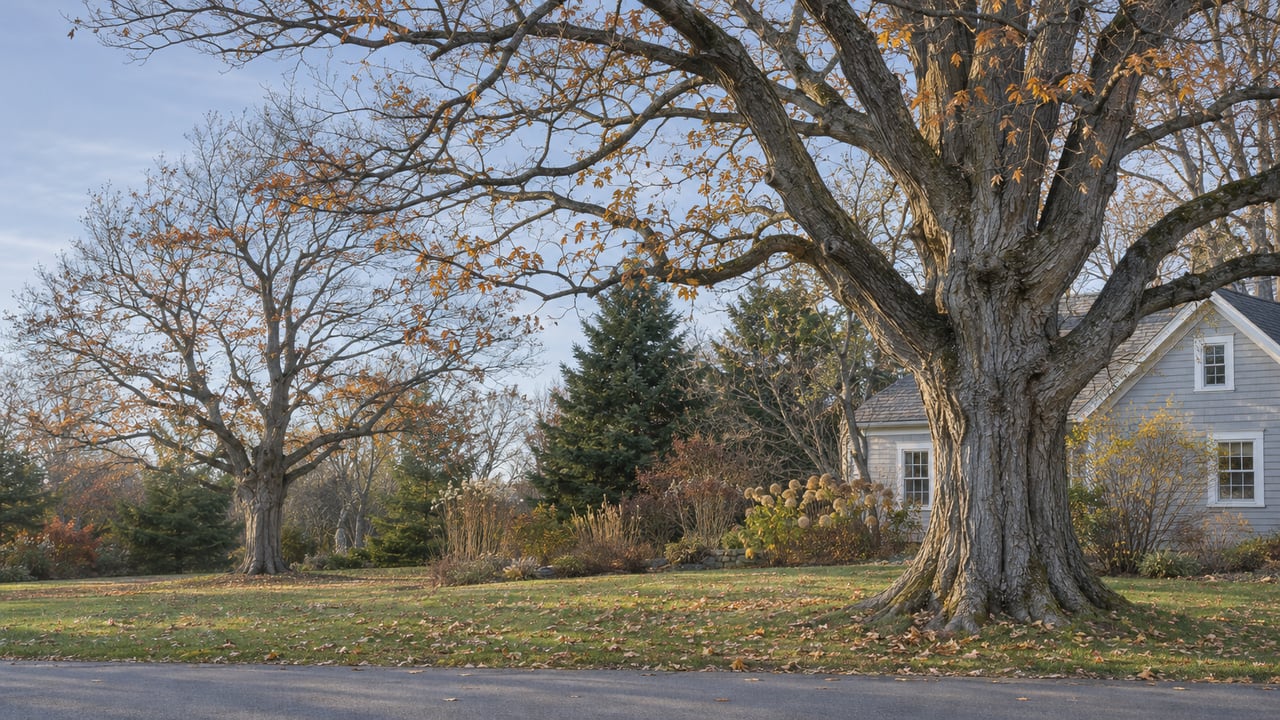
The September plan called for removing as many as ten full-grown maples along Lake Street.
The petition asked for a different order of work
The petition, led by Ella Skrocki, whose family owns Sleeping Bear Surf and who served on the Village Council from 2024 to 2026, did more than object to cutting trees. It argued that the village was starting at the wrong end of the hill.
"Based on firsthand observations of runoff along this corridor, the primary stormwater problem area extends from the top of Wilco Road to Aylsworth Street. Yet the majority of the proposed runoff mitigation efforts are below Aylsworth, in a comparatively flat area."
That passage comes from the petition text published by the Glen Arbor Sun. It asked the council to pause the tree removal and the sidewalk reconstruction and to finish the Wilco Road stormwater planning already underway with Sleeping Bear Dunes National Lakeshore first. It also asked the village to make the supporting documents public. It described mature trees as "functional green infrastructure" that intercept rainfall and help reduce runoff.
The petition's argument was about sequence: fix the steep section uphill first, then decide what the flat stretch downhill actually needs. The village had to settle the sequence question within the week.
A buried line and a November 15 cutoff
Davis told the council that several concerned residents had approached him over the weekend. On Monday, the engineer from Gosling Czubak, the village's engineering firm, called him after the crew hit trouble with a buried electrical line, according to the Enterprise. Consumers Energy couldn't move the line right away and said relocating it would take several weeks.
Asphalt isn't available after November 15, the paper reported. The village could change the plan or let the road wait. Davis said he made the changes himself because there was no time to wait, and he and the engineer agreed the trees could stay.
Several weeks for a utility relocation, counted from the last week of October, would have run past the asphalt cutoff. Waiting on Consumers Energy meant no paving this season. Leaving the trees in place meant Lake Street could still be paved. The petition explained why people wanted the trees saved, and the paving calendar settled it.
As of this week, Lake Street is still working against that November 15 date. The village's posted construction plans are the best place to follow the work.
Lake Street took most of this year's street money
The tree decision affects more than one block. In October the council began its annual review of the Capital Improvement Plan, its long-term schedule of major projects. Council member Maggie Bacon reminded everyone that the plan is meant to hold what the village can realistically accomplish, not serve as a "wish list," the Enterprise reported.
Here is how the street portion of that plan read in late October 2026:
| Street or project | Where it sits on the plan | Reported cost |
|---|---|---|
| Alley behind the library | Completed | |
| Lake Street | Grinding and replacement this year | Elmer's bid of $248,556 for the drainage project |
| Alley behind the Methodist Church, M-22 to Lake Street | Next on the list | |
| Front Street crack sealing | 2027–28 | About $25,000 |
| Salisbury and Phillips streets | Not expected until 2028–29 | |
| Front Street and Erie Street intersection | Listed for 2031–32, with a proposal to move it to 2028–29 | $100,000 |
The Front and Erie intersection is where the trade-off shows. Council member Meg Walton suggested moving it up to 2028–29 because of the road's "very bad" condition. Bacon answered: "Lake Street will have eaten up most of our local street money this year, but we could look at it for 28/29 if you wanted." She added that a few years ago MDOT had suggested a cheaper option, new pavement striping instead of fully reengineering the intersection.
Measured against the plan, Lake Street's cost is almost ten times the roughly $25,000 set aside for Front Street crack sealing, and about two and a half times the $100,000 penciled in for Front and Erie. A project that size uses up most of a village's local street budget for the year. If Lake Street had slipped into 2027 while waiting on a power line, every item below it in the table would have slipped too.
The same month, Empire applied for Tree City USA
The maples decision came the same month the village was seeking formal recognition for how it cares for its trees. The council voted unanimously in October to apply for Tree City USA designation, according to the Enterprise.
The program asks for four things: a tree ordinance, community tree-care spending of $2 per capita a year, a tree board or equivalent official, and an Arbor Day observance. Empire's Arbor Day event was held at Shalda Park, with a tree planting and a proclamation signed by Davis. Bob Joyce, head of the Department of Public Works, fills the official tree-care role and already handles much of the village's tree work.
Council member March Dye explained how the village meets the spending requirement. "We've actually spent $7,350 on tree removal, we have seven hours of tree assessment volunteer group work, 10 hours for the Arbor Day volunteers and tree trimming a whole lot of hours," she said, as quoted in the Enterprise. At its late September meeting, Dye was also one of the council members who raised concerns about how many Lake Street trees would come down, according to the Glen Arbor Sun.
Tree care already shows up in Empire's budget and in its volunteer hours. The ten Lake Street maples are now part of what that program covers.
A new loader, then a new council
Two other October decisions affect how the streets are maintained this winter and who sets the order of work after that.
The council approved a new front loader for $193,794.16 on a 6–1 vote, with Dye opposed. At an earlier special meeting, the council heard that the current loader sits idle about 60% of the time and isn't well suited to sand, and Joyce noted that it can't back-blade. Delivery is expected about 70 days after the purchase. The old loader will be sold on a public listing site open to municipalities and private buyers, at an expected $85,000 to $90,000.
The council deciding what comes after Lake Street will also look different. At the October 27 meeting where the clerk and treasurer were reappointed, Davis said, "I'm not going to be president in another month or so," according to the Enterprise. Here are the unofficial results from the November 3 general election, as posted by Leelanau County:
- Village president: Thomas Rademacher.
- Four-year trustee seats: Margaret Dye, Mark Dunphey and James Weller.
- Partial trustee term ending December 1, 2028: Sam Barr.
Under Michigan's General Law Village Act, a president and trustees elected at a regular village election take office on December 1 after they are elected and qualified. For this election, that's December 1, 2026.
The incoming council inherits several open items: the alley behind the Methodist Church as the next street project, the debate over moving the Front and Erie intersection to 2028–29, the Wilco Road stormwater planning with the National Park Service, and the Tree City USA application. The maples on Lake Street will still be standing when it takes office.
If you'd like to talk about how projects like this affect a particular street in the village, Jennifer Hastings and the Blue Lakes team know these blocks well. Let's Work Together.